
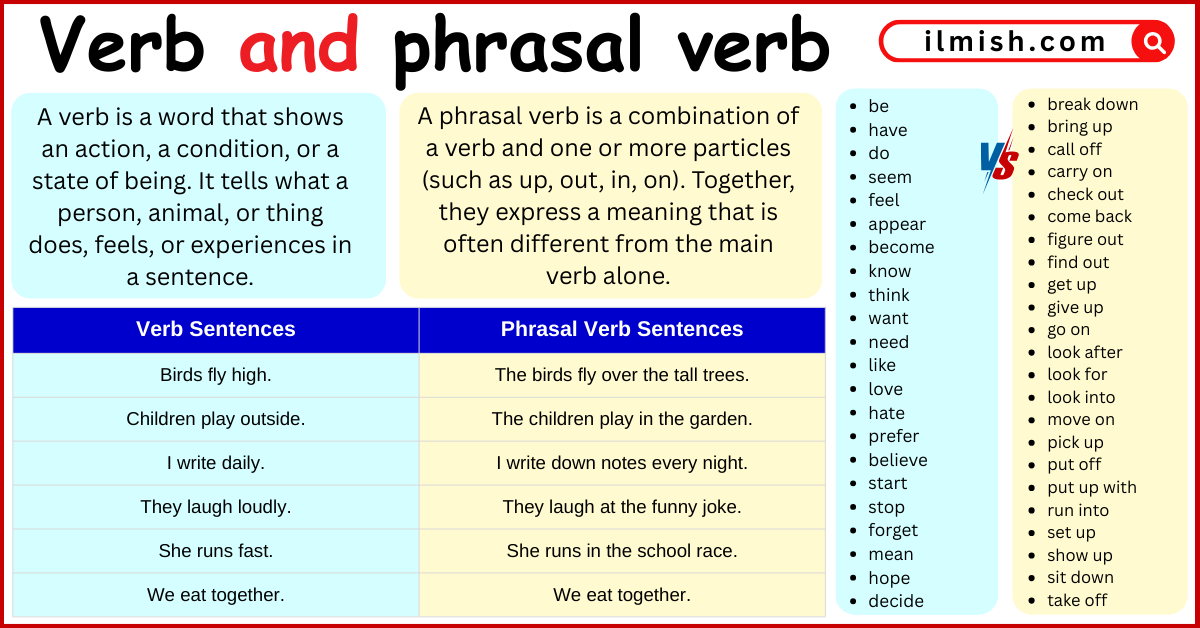
Verbs are basic action or state words in English, such as “run,” “eat,” or “think,” while phrasal verbs are made by combining a verb with a preposition or adverb, like “give up” or “look after.” Although they may seem similar, verbs and phrasal verbs often have different meanings and uses in sentences. Understanding the difference between them is important for speaking and writing English correctly. In this article, you will learn the clear difference between verbs and phrasal verbs in an easy and simple way, with examples that help you use them confidently in daily English.
Table of Contents
ToggleWhat Are Verb in English?
A verb shows an action, a state, or an occurrence in a sentence. It tells us what the subject does or what happens to the subject. Every complete English sentence needs a verb to express meaning.
Verbs are usually single words and carry the main idea of an action or condition.
Common Characteristics of Verb
- They can show action (run, eat, write)
- They can show state or condition (be, seem, exist)
- They change form according to tense, person, and number
Examples of Verb in Sentences
- She writes stories.
- They play football.
- He is tired today.
Types of Verb (Basic Understanding)
Understanding verb types helps learners recognize how verbs work differently in sentences.
Main Verbs
Main verbs carry the core meaning of a sentence.
Examples: eat, go, read, think
Helping (Auxiliary) Verbs
Helping verbs support the main verb and help form tenses or questions.
Examples: is, are, have, will
Linking Verbs
Linking verbs connect the subject with more information about it.
Examples: is, seem, become
What Are Phrasal Verbs in English?
Phrasal verbs are combinations of a main verb and one or more particles (prepositions or adverbs). Together, they create a meaning that is often different from the original verb.
Phrasal verbs are extremely common in spoken English, informal writing, and everyday conversations.
Structure of Phrasal Verbs
- Verb + Adverb
give up, wake up - Verb + Preposition
look after, believe in - Verb + Adverb + Preposition
get along with, look forward to
Examples of Phrasal Verbs in Sentences
- She gave up smoking.
- Please look after the child.
- He ran into an old friend.

Key Difference Between Verbs and Phrasal Verbs
The main difference lies in structure, meaning, and usage.
Comparison Table: Verbs vs Phrasal Verbs
| Feature | Verbs | Phrasal Verbs |
|---|---|---|
| Structure | Single word | Verb + particle(s) |
| Meaning | Usually direct and clear | Often idiomatic |
| Usage | Common in formal English | Common in informal English |
| Difficulty | Easier for learners | Harder due to hidden meanings |
| Exam Use | Preferred in formal writing | Used in speaking and comprehension |
Difference in Meaning and Usage
A verb usually keeps its original meaning, while a phrasal verb often has a new or figurative meaning.
Example Comparison
| Verb | Meaning | Phrasal Verb | Meaning |
|---|---|---|---|
| look | see | look after | take care |
| give | provide | give up | quit |
| turn | rotate | turn down | reject |
This difference is important for ESL exams, as misusing a phrasal verb can change the entire meaning of a sentence.
Formal vs Informal English Usage
Verbs in Formal English
Verbs are preferred in:
- Academic writing
- Exams and essays
- Business communication
Example:
The company rejected the offer.
Phrasal Verbs in Informal English
Phrasal verbs are common in:
- Conversations
- Emails to friends
- Daily spoken English
Example:
The company turned down the offer.
Both sentences are correct, but the tone is different.
Separable and Inseparable Phrasal Verbs
Separable Phrasal Verbs
The object can come between the verb and particle.
- She turned off the light.
- She turned the light off.
Inseparable Phrasal Verbs
The object cannot be separated.
He ran into trouble.
(Not: ran trouble into)
Common Mistakes ESL Learners Make
- Using phrasal verbs in formal essays
- Separating inseparable phrasal verbs
- Translating phrasal verbs word-for-word
- Confusing similar particles like up, out, off
Understanding context helps avoid these errors.
Tips to Master Verbs and Phrasal Verbs
- Learn verbs first, then phrasal verbs
- Study phrasal verbs in context
- Use tables and example sentences
- Practice speaking to improve natural usage
- Replace phrasal verbs with verbs in formal writing
Why This Difference Matters for Exams and Fluency
Knowing the difference between verbs and phrasal verbs helps learners:
- Write better essays
- Speak more naturally
- Understand native speakers easily
- Choose correct words in MCQs and comprehension tests
For ESL students, mastering this topic builds a strong foundation in English grammar and communication.
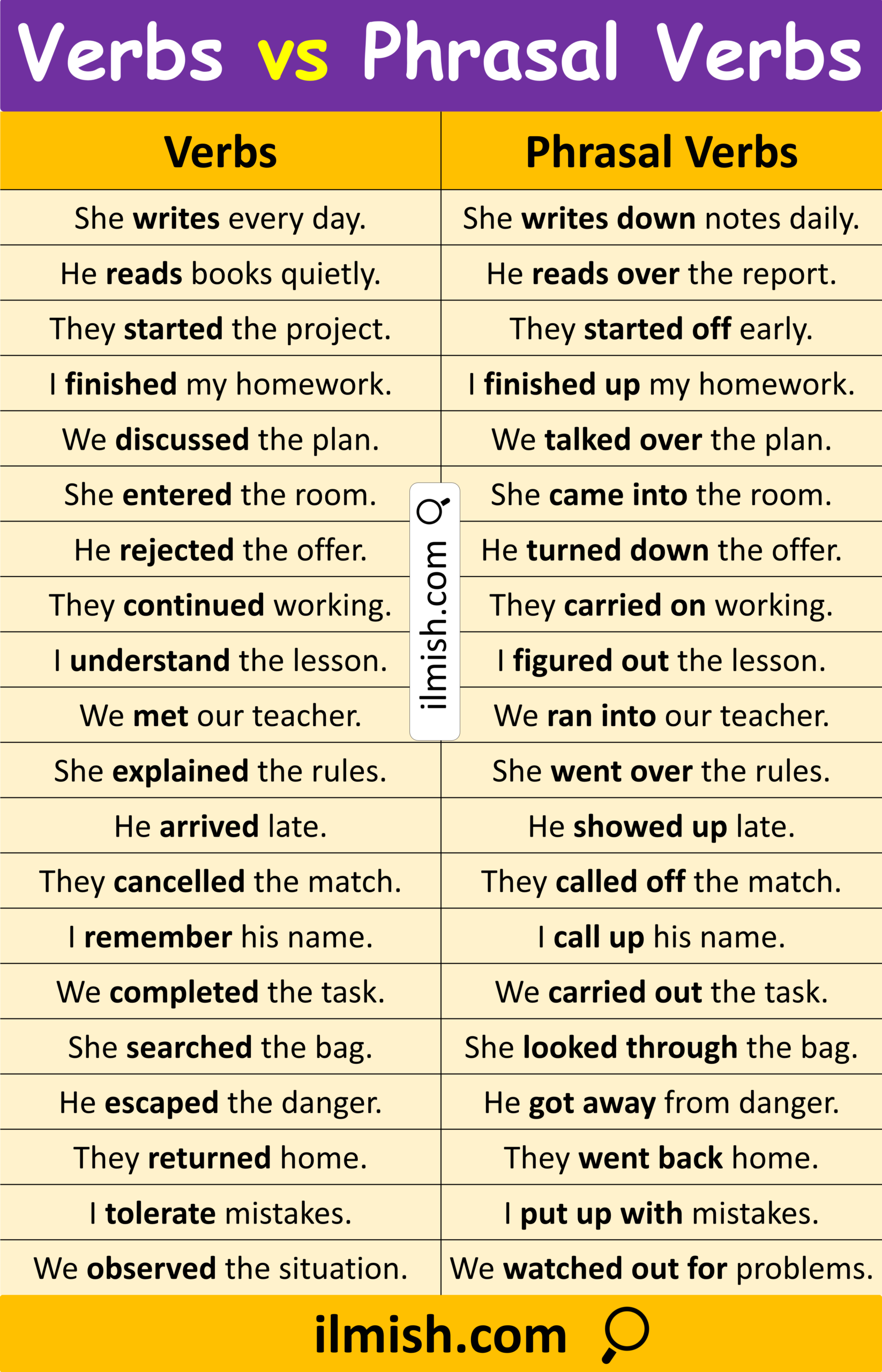
Examples of Verbs and Phrasal Verbs in English
| Verbs | Phrasal Verbs |
|---|---|
| She writes every day. | She writes down notes daily. |
| He reads books quietly. | He reads over the report. |
| They started the project. | They started off early. |
| I finished my homework. | I finished up my homework. |
| We discussed the plan. | We talked over the plan. |
| She entered the room. | She came into the room. |
| He rejected the offer. | He turned down the offer. |
| They continued working. | They carried on working. |
| I understand the lesson. | I figured out the lesson. |
| We met our teacher. | We ran into our teacher. |
| She explained the rules. | She went over the rules. |
| He arrived late. | He showed up late. |
| They cancelled the match. | They called off the match. |
| I remember his name. | I call up his name. |
| We completed the task. | We carried out the task. |
| She searched the bag. | She looked through the bag. |
| He escaped the danger. | He got away from danger. |
| They returned home. | They went back home. |
| I tolerate mistakes. | I put up with mistakes. |
| We observed the situation. | We watched out for problems. |
List of Verbs and Phrasal Verbs in English
- accept
- arrive
- ask
- build
- buy
- choose
- clean
- close
- complete
- decide
- eat
- enter
- explain
- finish
- help
- learn
- listen
- open
- read
- remember
- see
- start
- stop
- study
- teach
- think
- understand
- use
- visit
List of Common Phrasal Verbs in English
- break down
- bring up
- call off
- carry on
- check out
- come back
- find out
- get up
- give up
- go on
- grow up
- keep on
- look after
- look for
- look into
- move on
- pick up
- put off
- put up with
- run out
- set up
- show up
- sit down
- take off
- take over
- throw away
- turn down
- wake up
- work out
- write down

Learn more helpful articles