
What Are Adverbs in English?
An adverb is a word that modifies a verb, an adjective, or another adverb. It gives more information about an action, quality, or manner. Adverbs answer questions such as how, when, where, how often, and how much.
Examples:
- She speaks clearly.
- He arrived early.
- They work hard.
Most adverbs are formed by adding -ly to adjectives, but many common adverbs do not follow this rule.
What Are Adverb Phrases in English?
An adverb phrase is a group of two or more words that works together like an adverb. It gives extra details about the action in a sentence, just like a single adverb does.
Examples:
- She spoke in a confident way.
- He waited for a long time.
- They met at the end of the day.
Adverb phrases often include prepositions, nouns, or modifiers, but they function as one unit.
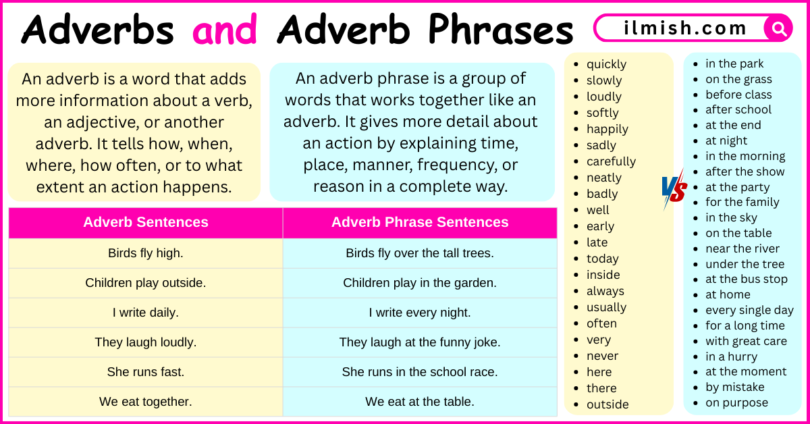
Difference Between Adverbs and Adverb Phrases
Difference Between Adverbs and Adverb Phrases
Understanding the difference helps learners avoid confusion in exams and writing.
Comparison Table
| Adverbs | Adverb Phrases |
|---|---|
| Single word | Group of words |
| Short and direct | More descriptive |
| Often ends in -ly | Does not follow a fixed form |
| Easier to use | Gives detailed meaning |
Types of Adverbs in English
Adverbs can be grouped according to the type of information they provide.
Adverbs of Manner
These adverbs explain how an action happens.
Examples:
- She sings beautifully.
- He drives carefully.
Common adverbs of manner:
slowly, quickly, politely, badly, well
Adverbs of Time
These adverbs tell when an action happens.
Examples:
- I will call you later.
- She arrived yesterday.
Common adverbs of time:
now, today, soon, already, finally
Adverbs of Place
These adverbs show where an action happens.
Examples:
- The children are playing outside.
- He looked everywhere.
Common adverbs of place:
here, there, inside, nearby, away
Adverbs of Frequency
These adverbs tell how often an action happens.
Examples:
- She always wakes up early.
- They sometimes travel together.
Common adverbs of frequency:
always, usually, often, rarely, never
Adverbs of Degree
These adverbs explain how much or to what extent.
Examples:
- The movie was very interesting.
- He is too tired.
Common adverbs of degree:
very, too, quite, almost, enough
Types of Adverb Phrases
Adverb phrases also perform different functions depending on their meaning.
Adverb Phrases of Manner
They explain how something is done.
Examples:
- She spoke with great confidence.
- He worked in a careful way.
Adverb Phrases of Time
They show when something happens.
Examples:
- We met in the morning.
- He left after the meeting.
Adverb Phrases of Place
They explain where an action occurs.
Examples:
- The keys are on the table.
- She waited at the bus stop.
Adverb Phrases of Frequency
They tell how often something happens.
Examples:
- He visits us from time to time.
- She checks her email every day.
Position of Adverbs and Adverb Phrases
Adverbs and adverb phrases can appear in different positions in a sentence.
- Beginning: Yesterday, we finished the work.
- Middle: She often visits her parents.
- End: He spoke politely.
Correct placement improves clarity and natural flow.
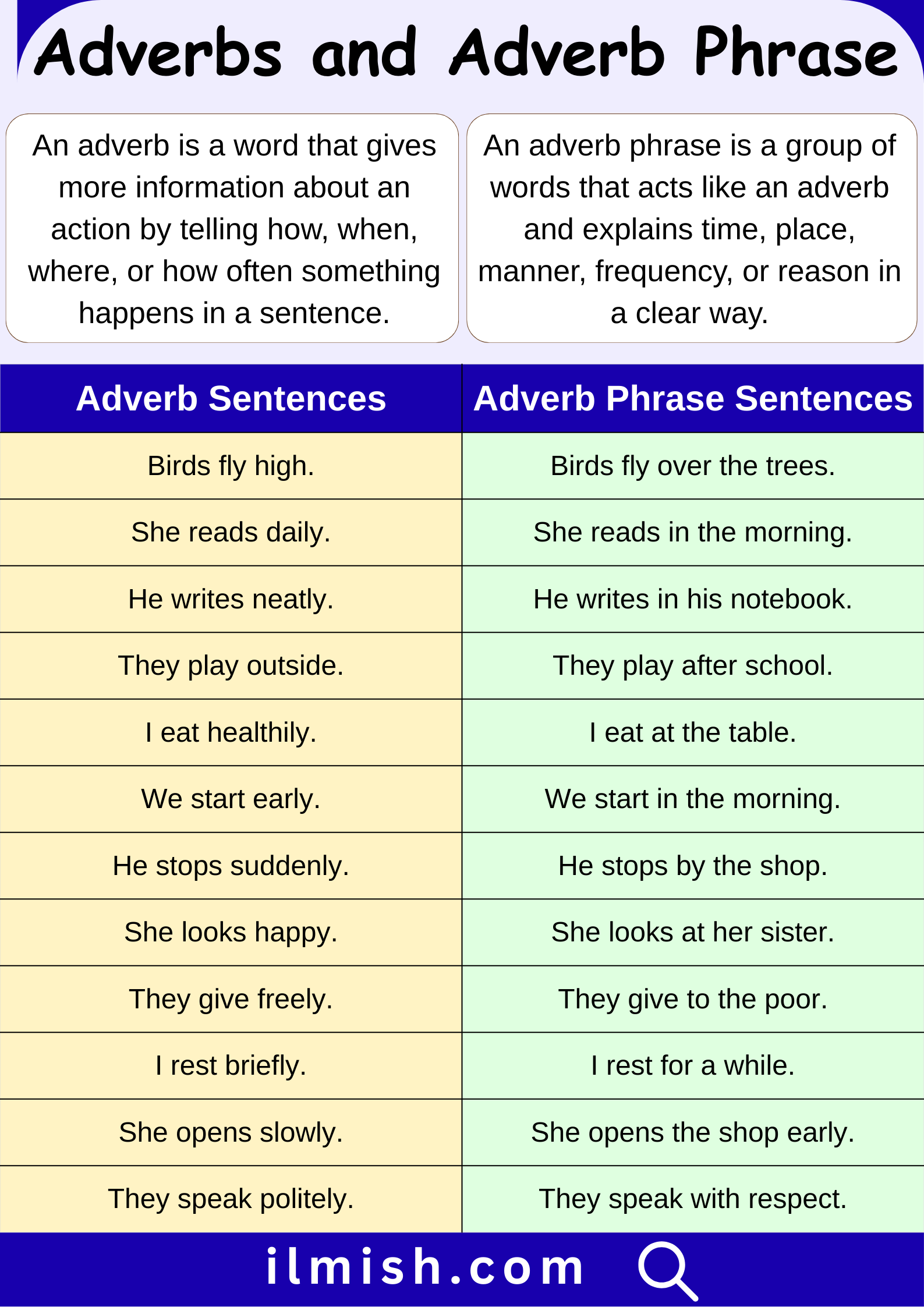
Adverbs vs Adverb Phrases: Example Table
| Adverb Sentence | Adverb Phrase Sentence |
|---|---|
| She answered quickly. | She answered in a quick manner. |
| He arrived late. | He arrived after a long delay. |
| They spoke softly. | They spoke in a low voice. |
| I waited patiently. | I waited for a long time. |
| She worked hard. | She worked with great effort. |
Why Adverbs and Adverb Phrases Matter in Exams
For ESL students, this topic helps in:
- Sentence correction questions
- Grammar MCQs
- Essay and paragraph writing
- Speaking and listening tasks
Correct usage shows strong grammar control and clear expression.
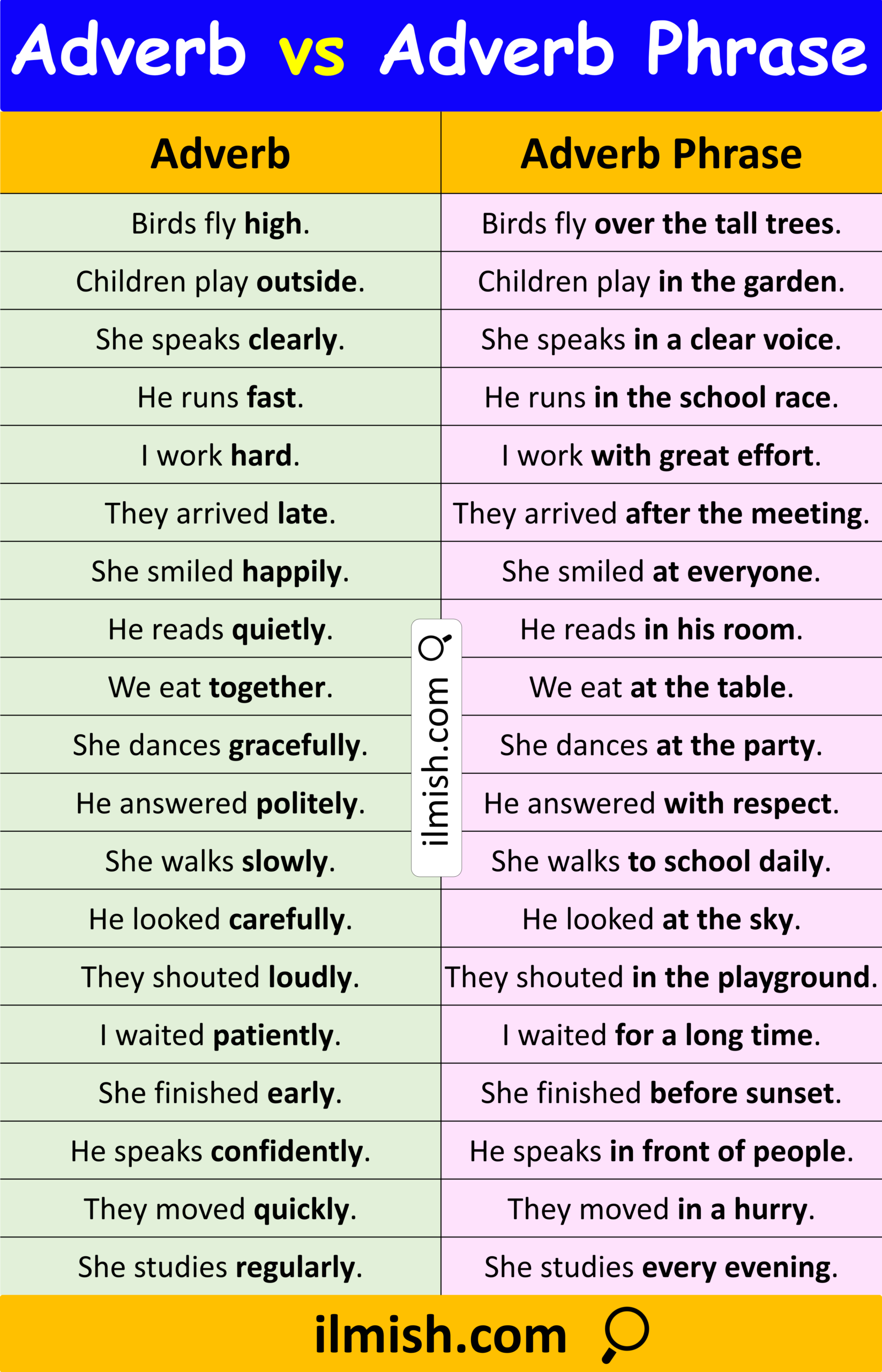
Examples of Adverbs and Adverb Phrases in English
| Adverb Sentences | Adverb Phrase Sentences |
|---|---|
| Birds fly high. | Birds fly over the tall trees. |
| Children play outside. | Children play in the garden. |
| She speaks clearly. | She speaks in a clear voice. |
| He runs fast. | He runs in the school race. |
| I work hard. | I work with great effort. |
| They arrived late. | They arrived after the meeting. |
| She smiled happily. | She smiled at everyone. |
| He reads quietly. | He reads in his room. |
| We eat together. | We eat at the table. |
| She dances gracefully. | She dances at the party. |
| He answered politely. | He answered with respect. |
| The baby slept peacefully. | The baby slept through the night. |
| She walks slowly. | She walks to school daily. |
| He looked carefully. | He looked at the sky. |
| They shouted loudly. | They shouted in the playground. |
| I waited patiently. | I waited for a long time. |
| She finished early. | She finished before sunset. |
| He speaks confidently. | He speaks in front of people. |
| They moved quickly. | They moved in a hurry. |
| She studies regularly. | She studies every evening. |
Examples of Adverbs and Adverb Phrases in English
List of Adverbs and Adverb Phrases in English
- quickly
- slowly
- loudly
- softly
- happily
- sadly
- carefully
- carelessly
- neatly
- badly
- well
- early
- late
- today
- tomorrow
- always
- usually
- often
- sometimes
- never
- here
- there
- inside
- outside
- upstairs
- downstairs
- very
- too
- quite
- together
List of Adverb Phrases
- in the park
- on the grass
- in the garden
- at the table
- in the morning
- at night
- after school
- before class
- at the party
- in the room
- on the road
- under the tree
- near the river
- at the bus stop
- in the playground
- for a long time
- in a hurry
- with great care
- from time to time
- every single day
- at the moment
- by mistake
- on purpose
- in front of people
- behind the house
- at home
- in the sky
- after the meeting
- before sunset
- during the break
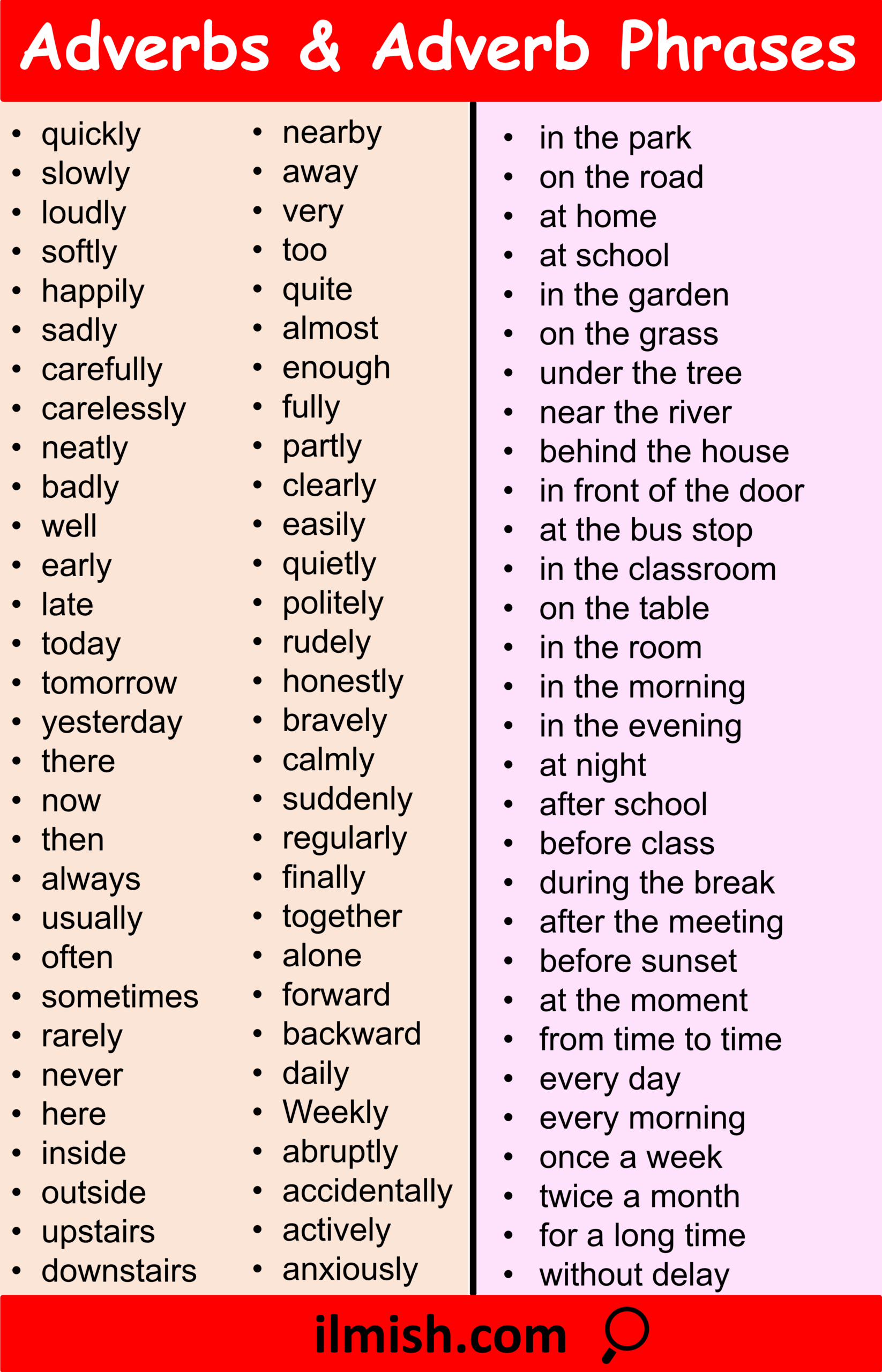
List of Adverbs and Adverb Phrases in English
Learn more helpful articles